
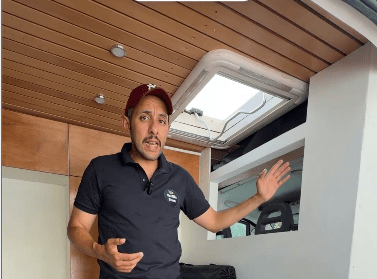
Keeping or removing your van’s partition: the question that changes your entire layout
It is one of the most structuring decisions of your van layout: do you keep the partition that separates the driving cabin from the living space, or do you remove it to gain space and light?
There is no universal right answer. The choice depends on your van usage, your sensitivity to cold, the number of people on board, and your vehicle’s profile.
In this guide, we cover the real trade-offs: brightness, perceived space, thermal insulation, interior layout possibilities. You leave with concrete elements to decide. The video above summarizes everything in 35 seconds.
What is the purpose of the original partition in a van?
The original partition is the metal wall that separates the driving cabin (front seats, windshield, front side windows) from the usable space at the rear. On L2H2 vans (Ducato, Boxer, Master, Sprinter), it often includes a standard opening of about 90 × 40 cm, sometimes removed or widened by the owner.
This partition has two structuring roles:
- A thermal insulation function: it forms a physical barrier between the poorly insulable front (windshield, windows) and the rear where you live.
- A layout function: its rear side often serves as a support to install a worktop, a sink, or vertical storage.
It is by balancing these two functions and the freedom of space that you make your decision.
Keeping the partition: the advantages
1. Significantly better thermal insulation
This is the most important point for those living in their van during cold seasons. The driving cabin is extremely difficult to insulate: a windshield remains a windshield, and the front side windows are not designed to block thermal transfers.
When the partition is in place and properly insulated—typically with Armaflex on its walls—you create a buffer zone. The thermal transfer between front and rear is greatly reduced, and your heater becomes more efficient.
Without a partition, even with blackout foams on the windshield, you will never reach the same level of insulation. It’s a physical reality: a closed and insulated volume retains heat, an open volume with a large glazed surface loses it.
To properly insulate your partition, we recommend Armaflex AF 19 mm or Armaflex AF 25 mm self-adhesive. It is the market reference for campervans: vapor barrier, best lambda at equal thickness, easy installation.
2. A natural worktop
The rear face of the partition is an ideal support for fitting a kitchenette: sink, cooking hob, worktop, vertical storage. Since no passage is needed here (except for the 90 × 40 cm opening), you gain valuable usable space.
This is typically where the sink, utensils, and dry goods storage are located. In an L2H2 where every centimeter counts, this surface can make the difference between a functional kitchen and a compromise.
Keeping the partition: the disadvantages
1. Reduced brightness
The partition blocks natural light coming through the windshield and front windows. The standard 90 × 40 cm opening lets in some daylight, but the "tunnel" effect remains noticeable — especially if you live in your van during the day.
Some converters even go as far as removing this opening, which completely closes off the partition. The brightness in the living space then depends solely on the side windows and rooflights.
If you keep the partition, compensate for the brightness with a Panorama Slim 3 LED rooflight or a Panorama LED 50×70 rooflight that brings a large amount of light through the roof, as well as well-sized side windows.
2. A perceived smaller living space
Beyond the light, it is the feeling of space that changes. A closed partition visually shortens the inhabited volume. The eye only perceives the rear area, whereas the windshield could provide an additional depth of several meters.
For those who spend a lot of time inside, this difference can be significant.
Removing the partition: the advantages
1. An expanded living space
In an L2H2, removing the partition changes the perception of the interior volume. The windshield becomes a large visual opening to the outside, and the living space extends all the way to the front.
Specifically, this also allows the installation of swivel seats in the front seats. By turning the seats to face the rear, you create a true lounge for 4 people — not 4 people sleeping on board, but 4 people who can gather inside the vehicle for a meal or a break.
2. Simplified front-to-back communication
Without a partition, you can move freely from one area to another without having to duck to get through a narrow opening. This comfort is appreciated daily, especially for couples with children or for those who often stop for short breaks without leaving the vehicle.
Removing the bulkhead: the drawback not to overlook
Thermal transfer becomes massive
This is strongly emphasized in the video: a windshield and front side windows are not designed to be insulated. Even with foam, thermal blinds, or cab covers, you will never achieve the insulation level of a closed bulkhead treated with Armaflex.
The result: in winter, the cab cools down quickly and drags your entire living space with it. Your heater works harder, you consume more, and the gap between outside and inside temperature levels off faster.
If you plan to use your van in cold seasons (mountains, off-season), this is a key factor in the decision. Compensate as much as possible with Armaflex on all your walls and effective thermal blinds on the windshield.
How to decide based on your profile?
You keep the bulkhead if:
- You use your van in winter or in the mountains
- You want a complete kitchenette with sink and vertical storage
- You travel as a couple and don’t need a lounge space for 4
- Thermal insulation is a priority
You remove the bulkhead if:
- You want to maximize perceived living space, especially on L2H2
- You install swivel seats for a convivial lounge
- You mainly travel in mild seasons
- Brightness and the feeling of space are priorities
- You are ready to compensate for insulation with a more powerful heater and effective thermal blinds
Intermediate solutions
Some converters opt for compromises:
- Keep part of the bulkhead only on the kitchenette side, and open the other half
- Install a removable bulkhead (thick thermal curtain, removable panel) to benefit from insulation in winter and space in summer
- Enhance cab insulation with a thermal cab cover kit + multi-layer windshield thermal blinds
None of these solutions match a fixed insulated bulkhead, but they allow for seasonal compromise.
Frequently Asked Questions (FAQ)
Should I remove the bulkhead from my panel van conversion?
It depends on your priorities. If thermal insulation and the possibility of installing a kitchenette are paramount, keep it. If living space, brightness, and conviviality for 4 people are priorities, remove it. There is no universal right answer.
What is the standard opening size for a panel van bulkhead?
On most L2H2 models (Ducato, Boxer, Master, Sprinter), the original opening is about 90 × 40 cm. Some converters keep it, others widen it or remove it completely.
Can you insulate the cab of a panel van conversion without a bulkhead?
Heat loss can be limited with thermal blinds on the windshield and front side windows, insulating seat covers, and thick floor mats. But the result will never match a closed partition treated with Armaflex. The windshield remains an uninsulated glazed surface by design.
How to install a sink on a panel van partition?
The rear face of the partition is a solid support that allows fixing a kitchen unit including sink, hob, storage, and workspace. You usually keep the 90 × 40 cm opening for passage and fit out on both sides.
Swivel seats: should the partition be removed?
To fully use swivel seats (rotating 180° backward), it is generally necessary to remove the partition. Some panel vans allow partial rotation despite the partition, but comfort and safety are reduced.
Which insulation to use for the partition of a panel van conversion?
Armaflex AF (Armacell) in 19 mm or 25 mm thickness is the market reference for Campervan conversions. It is self-adhesive, vapor barrier, and offers the best lambda at equal thickness.
What decision will you make?
The panel van conversion partition is a trade-off between insulation and conversion on one side, and space and brightness on the other. Neither option is inherently better — it all depends on your intended use.
Before cutting or closing off permanently, ask yourself three questions: will I use my van in cold seasons? Does my interior conversion need the workspace provided by the partition? Is the perceived living space an essential criterion for me?
A question about your project? We’ll answer you
If you hesitate before cutting, take the time to discuss it with our technical team. Our conversion experts answer your questions for free, with no obligation, and guide you based on your vehicle, usage, and travel season.
➡️ Contact the Vanlife Store technical team
The equipment to properly outfit your choice
- To insulate your partition or walls: see our complete Armaflex range (6 mm, 10 mm, 19 mm, 25 mm + adhesive tape + cleaner).
- To compensate for brightness if you keep the partition: see our rooflights and roof openings.
- To add side windows: see our Campervan windows and window blind and mosquito net collection (VASP 43-R approved, with window blind and mosquito net).